Ads and finance push ChatGPT's trust stack into view
Ads and personal finance entering ChatGPT at the same time make OpenAI's real challenge clearer: context, commercialization, and trust have to coexist.
Summary
ChatGPT moving into ads and personal finance at the same time exposes something larger than two product updates. It exposes the trust stack. Ads ask OpenAI to use context to place commercial content. Personal finance asks OpenAI to connect more sensitive data so answers can become more relevant. Put together, the question becomes whether the same assistant can understand the user deeply without turning that understanding into commercial pressure.
That is harder than ordinary product monetization. Search ads usually appear near commercial queries, where users already know they are in a market-shaped environment. Personal finance conversations happen when users are trying to plan, restrain themselves, or make consequential tradeoffs. If ChatGPT starts to feel like an advisor with a commercial agenda, the loss is not a single click. The loss is the assistant identity.
The shared theme, then, is trust infrastructure. Ads need labeling, answer independence, and limits around sensitive categories. Finance needs data control, boundaries around professional advice, and transparent assumptions. If any layer is vague, users will ask the only question that matters: was this answer for me, or for the platform’s revenue?
What happened
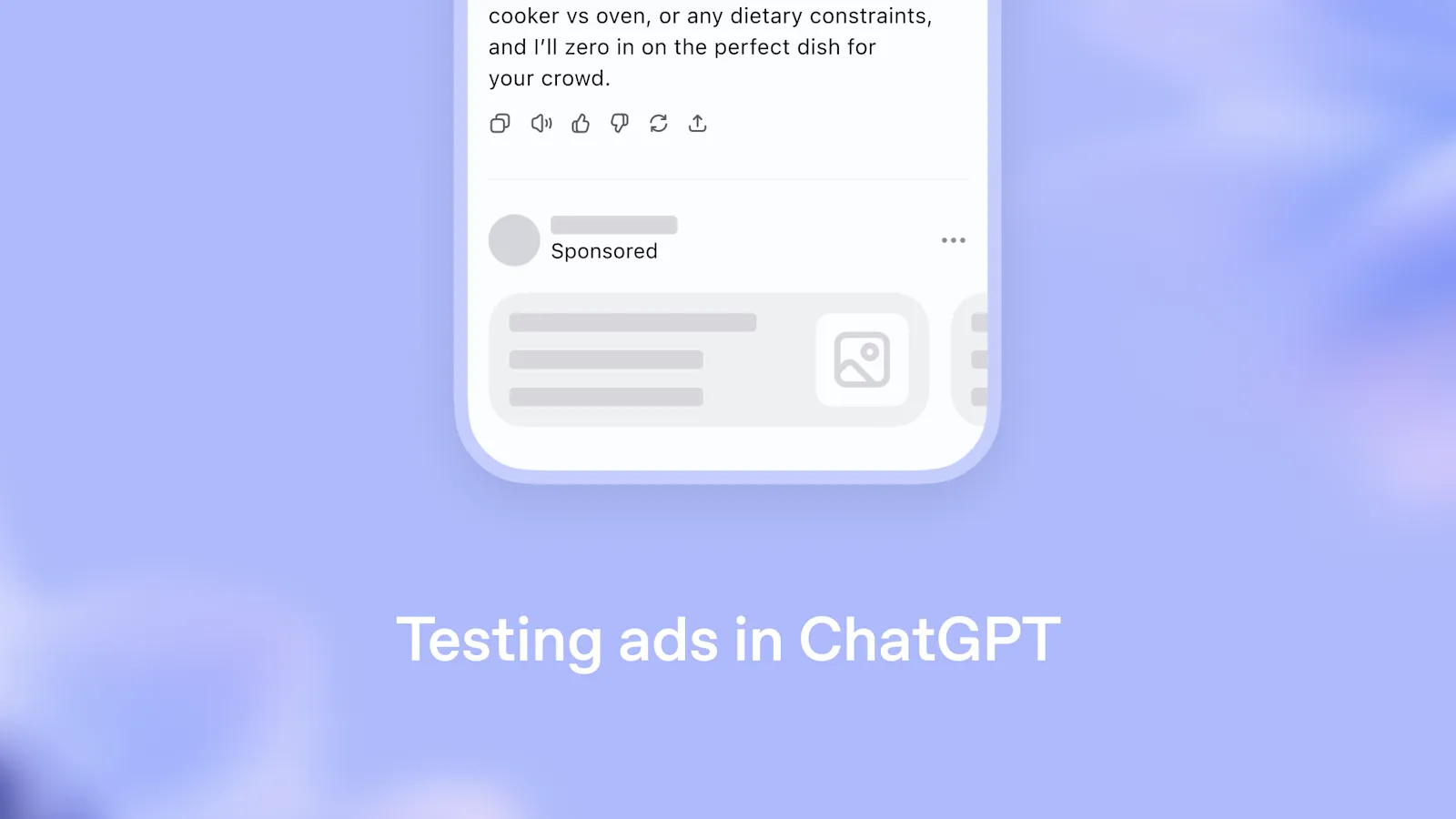
OpenAI’s ads pilot brings labeled commercial content into ChatGPT while using ad policies to constrain eligible content, sensitive areas, and presentation. The official framing stresses that ads should be distinguishable from normal answers, advertisers should not see conversation content, and commercial content should not alter the model’s response. The core product judgment is clear: ads may appear, but they cannot contaminate trust in the answer.
The personal finance experience moves in the other direction. Users can connect financial accounts, view a dashboard, and ask questions about spending, subscriptions, goals, investment risk, and future plans. The release and help materials put control, data use, and the boundary around professional financial advice near the center of the product. Its value comes from more context, and its risk comes from more context too.
Together, these lines show ChatGPT becoming a context product. It may know the user’s subscriptions, cash flow, goals, and remembered preferences rather than merely explaining what a budget is. It may use the user’s current intent and broader context to decide which commercial content is relevant rather than merely showing a static ad. The deeper the context, the more explicit the trust stack has to become.
Why it matters
This matters because ChatGPT’s long-term business model will be constrained by trust. OpenAI can use ads to subsidize free usage, and it can use finance to increase the value of premium experiences, but both paths depend on the same premise: users believe the assistant is not monetizing their vulnerable moments against them. If that premise breaks, smarter features become more dangerous rather than more valuable.
Ads and finance also amplify each other’s risks. If the ad system uses past chats and memory, financial context has to be tightly isolated. If a financial assistant operates near investment, lending, or consumption decisions while commercial content appears nearby, users will naturally ask whether the recommendation and the ad are related. Even if the architecture separates them, the interface and policy have to make that separation understandable.
For the broader industry, this may define the commercialization pattern for consumer AI. Personal AI cannot rely on subscriptions forever, and it cannot avoid sensitive data forever. The real question is whether platforms can establish rules users accept: which context can be used for personalization, which can only be used for answering, which must be isolated, and which commercial content should never come close.
Builder impact
Builders should decompose the trust stack into operational layers. The first layer is source: which accounts, memories, conversations, or external data informed this output. The second is purpose: whether that data was used to generate an answer, personalize a product surface, or match an ad. The third is control: whether the user can disable, delete, correct, and inspect it. The fourth is audit: whether the system can explain why a given answer or ad appeared.
Finance products need to avoid the ambiguous zone where insight looks like advice. Budget observations, subscription cleanup, and cash-flow explanations are different from specific investment, lending, or insurance recommendations. Products should tier actions by risk and slow down, ask for confirmation, or refuse when the user crosses into high-stakes territory. The more personal the assistant feels, the more clearly it must know when not to speak.
Ad products have to prove that commercial systems do not silently write back into assistant memory. A click on an ad should not quietly bias future answers. Deleting a memory should genuinely affect ad matching. Trust is not a policy paragraph; it is system behavior the user can see and operate.
What to ignore
Ignore the simplified question of whether ChatGPT should have ads at all. Free products need revenue, and that part is not complicated. The difficult question is whether ads can exist without bending answers, invading sensitive context, or weakening trust in finance, health, and other consequential conversations.
Ignore the idea that personal finance is just another data connector. Connected accounts make answers more relevant, and they also make users more likely to treat the output as authoritative. The system has to expose assumptions, limits, and advice boundaries, because the more data it sees, the higher the cost of misplaced trust.
Finally, ignore promise language as proof. The details that matter are control panels, deletion behavior, ad preferences, financial memory, and isolation around sensitive scenarios. A trust stack is not built by saying users control their data. It is built through product behavior that users can verify repeatedly.